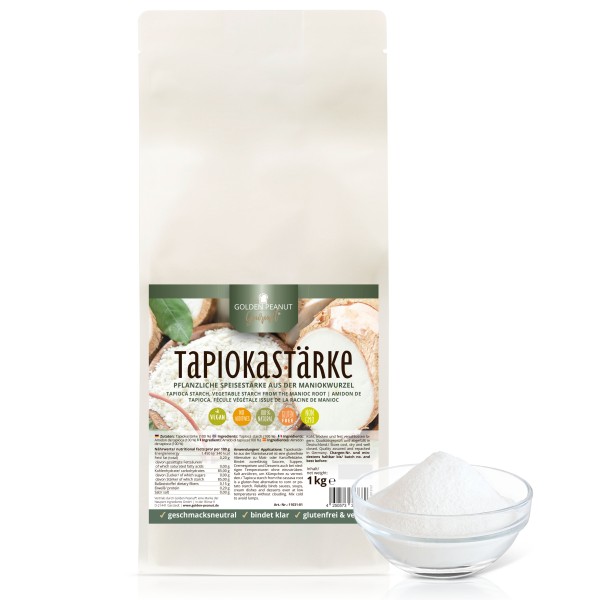
Tapioca starch
Natural starch from the cassava root




Prices incl. VAT plus shipping costs
Ready for immediate shipment, delivery time approx. 1-3 workdays
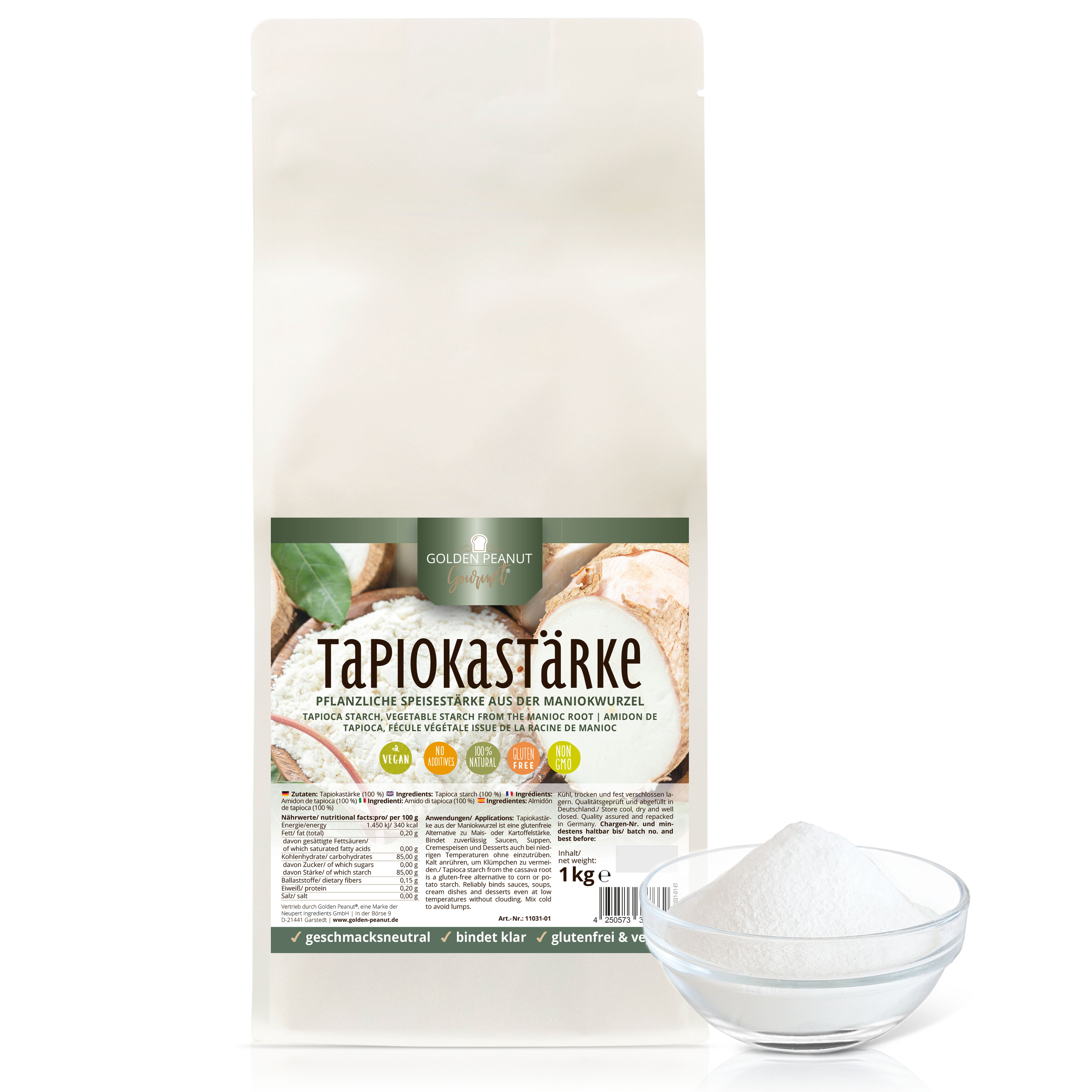
- Article No.: 11031-01
- Binds clear
- Gives a smooth consistency
- Gluten-free, vegan food starch

Tapioca starch is obtained from the root tuber of the cassava plant, which is native to tropical countries. There it is also known as cassava or yuca and is consumed as a staple food, similar to potatoes here. There are numerous recipes for preparing cassava. In South America, it is peeled, then ground and left to soak. After pressing, the starchy tuber yields a flour that can be used in the same way as wheat flour, but is gluten-free. A by-product of the production of cassava flour is starch, which is called tapioca starch.
Tapioca starch, which has no flavour of its own, is particularly good for thickening clear soups and sauces. It gives them a velvety consistency. Tapioca starch is mainly used in Asian cuisine, for example to make the well-known kroepoek (crab bread). If the starch is pressed through coarse sieves and then hot-dried, tapioca pearls are obtained, also known for the preparation of bubble tea.
- 100 % natural product
- Contains calcium, potassium and magnesium
- Ideal for binding clear liquids
- Gluten-free
- Vegan
- Neutral in taste
- No added sweeteners, colours or preservatives
- Flavour safe packed in sustainable food packaging
- Laboratory tested and filled in Germany
Tapioca starch (100%)
| per 100 g | |
|---|---|
| Energy value | 1.450,00 kj / 340,00 kcal |
| Fat | 0,20 g |
| - of which saturated fatty acids | 0,00 g |
| Carbohydrates | 85,00 g |
| - of which sugars | 0,00 g |
| - of which starch | 85,00 g |
| Dietary fiber | 0,15 g |
| Protein | 0,20 g |
| Salt | 0,00 g |
To bind approx. 1 litre of liquid, 5-6 tablespoons of tapioca starch are needed. Mix cold to avoid lumps. Binds clearly, even at low temperatures. Can be used as a substitute for potato or corn starch to thicken soups, sauces, puddings and cream dishes.
Raw materials are subject to strict quality controls, which we naturally adhere to. When selecting suppliers in Germany and the countries of origin, we ensure that all European standards are met, that the products are tested in the laboratory and that the analytical data comply with the strict product specifications. Our suppliers have many years of experience and all the certifications required to ensure consistently high quality (e.g. ISO 22000, IFS, BRC, FSSC or similar). We regularly audit our suppliers on site in order to convince ourselves of these high standards and to control all processes in the supply chain.
We focus on sustainability and want to meet the highest demands. That is why Golden Peanut offers you products of German quality. All products, which originally come from different countries all over the world, are checked in Germany for residues and carefully controlled. Only if a perfect quality is determined, the raw materials are processed further in Germany or filled into finished packages. In order to ensure marketability, we have our product labels checked for correct declaration before they are placed on the market.
Product illustrations may differ in color, design and batch-related information.
- We are certified organic by the inspection body DE-ÖKO-003 LACON
- All products are filled in Germany under hygienically safe conditions
- Bottling is regularly checked by the state food inspection authority and is carried out according to the HACCP concept
- We only use aroma safe and food safe packaging with EU conformity certificate
- Our product labels are checked by accredited laboratories for the correctness of the declaration
- All processes in the supply chain are subject to regular controls by official bodies
- We guarantee a complete traceability of all components of our products from the origin to the finished product
- Our products are marketable in stationary trade by marking with scanable EAN barcodes
Should you require larger quantities (e.g. for your own distribution, also as private label), please do not hesitate to contact us.
 Locust bean gum
 - pure vegetable filler
- almost odourless and tasteless
- binds when warm
 Xanthan Gum
 - cold and hot soluble
- forms temperature-stable viscous solutions
- prevents the formation of ice crystals
 Arrowroot starch
 - binds clearly, even at low heat
- neutral in taste
- gluten-free
 Organic guar gum 5000 highly viscous
 - 8 x more effective than starch
- almost odourless and tasteless
- cold and warm soluble
 Blue Spirulina Powder Sea Blue
- high-quality, vegetable protein source
- gently extracted from freshwater microalgae
- natural food colouring without additives
 Organic Yacon Syrup
- Natural sweetness
- Fewer calories than sugar
- From the Peruvian ground apple
 Organic guar gum 3500
 - 100% natural product
- 8 x more effective than starch
- binds in cold and warm condition
 MSM PUR Tabletten
- Nahrungsergänzungsmittel
- MSM Tabletten in höchster Reinheit
- Reicht für 180 Tage
 Citrus pectin
 - vegan thickener and gelling agent
- for icing, jam, jelly and marmalade
- high yield and safe to use
 Bio vital wheat gluten
 - makes dough elastic
- high viscosity
- the shelf life of baked goods
 Organic hemp seeds, peeled
 - rich in omega 3 and 6 fatty acids
- trendy source of protein
- natural raw food from Europe
 Organic Chia Seed (Salvia hispanica)
 - rich in Omega 3 fatty acids
- gluten free and vegan
- checked in Germany for arrears
 Organic Spirulina pellets
 - extra small pellets
- Manufacture without tablet additives
- Raw food quality
 Organic Pea Protein
 - Isolate with 80 % protein content
- purely vegetable
- high content of branched-chain amino acids (BCAA)
 Organic Psyllium Husk Powder99
 - Powder from premium flea seed shells 99 % purity
- pure natural product
- rich in fibre and mucilage
 Organic Psyllium Husks95
 - free from gluten and other additives
- rich in fibre and mucilage
- with guarantee of origin
 Turmeric Spice Powder
 - 100% natural without additives
- for seasoning and refining
- Origin India
 Guar gum 5.000 cps. high viscosity
 - 8 x more effective than starch
- almost odourless and tasteless
- cold and warm soluble
Locust bean gum - pure vegetable filler
- almost odourless and tasteless
- binds when warm
 Guar gum 3.500 cps
 - 100% natural product
- 8 x more effective than starch
- binds in cold and warm condition
 Indian Premium Psyllium Husks99 % ground
 - Powder from premium flea seed shells 99 % purity
- pure natural product
- rich in fibre and mucilage
 Apple pectin E 440
 - natural gelatine substitute
- for jam and jelly
- Origin Europe
 Organic cocoa nibs
- 100 % natural product
- Produced by fair trade companies
- From the fine cocoa variety Criollo
 Vital wheat gluten
- ideal for the vegan diet
- ideal for making meat substitutes such as seitan
- for cake and bread dough
 NurBio® Maca Powder
 - Peruvian organic product from direct import.
- 100% pure Maca powder, no mixture
- Yellow maca root in raw food quality
Xanthan Gum - cold and hot soluble
- forms temperature-stable viscous solutions
- prevents the formation of ice crystals
 NUR BIO® Spirulina pellets
 - Extra small pellets
- Manufactured without tableting agents
- Raw food quality
 Organic Chia Oil
 - 63 % omega-3
- cold pressed and without additives
- fine nutty taste
 COCO Organic coconut blossom sugar
- without additives, not refined
- with a fine caramel note
- for cooking, baking and sweetening
 YO! Yummy Yacon
 - Trendy, low-calorie organic sweetener
- Ideal for mueslis and sports drinks
- In the practical squeeze bottle
Organic Chia Seed (Salvia hispanica) - rich in Omega 3 fatty acids
- gluten free and vegan
- checked in Germany for arrears
 Organic Cocoa Nibs
 - 100 % natural product
- Manufactured by fair trade operators
- from the fine cocoa variety Criollo
 Organic hemp protein
 - high content of branched-chain amino acids (BCAA)
- with a high content of polyunsaturated fatty acids
- tested for THC in Germany
 Whole milk powder
 - ideal for on the go
- made in Germany
- can be mixed hot and cold
 Dry Glucose Powder
 - corresponds to approx. 1/3 of the sweetening power of household sugar
- ffor making liqueur and ice cream
- gluten-free and vegan
 Vital wheat gluten
 - without additives
- tested for harmful substances
- versatile
 Sodium bicarbonate
 - German food quality
- suitable for many household applications
- gluten-free and vegan
 Vitamin C - Ascorbic acid
 - 100 % pure without additives
- natural antioxidant
- GMO free (not genetically modified)
Locust bean gum - pure vegetable filler
- almost odourless and tasteless
- binds when warm